Having a recurrent Card Err! on your camera memory card? We tried a couple of ideas and this really sorted it.
1) Camera chooses not to be able to read the card it did two minutes ago. Solution: clean it. First clean the card slot by wiggle a few cm of Velcro hooks. The gritty surface helps. Next buff up the contacts of the Smart Media card - use a cloth and a few drops of brass/silver polish. Try, I hope it works for you.
2) Deleted some pictures on the card you thought were not worth keeping two minutes ago. Solution: You need a half decent unerase prgram. Get that from PC Inspector (CONVAR) - Google for this. It costs a very generous nothing. Heed all warnings about unerasing files of the hard disc (it can do this too - but there are reasons to be careful).
Monday
Tuesday
Out of Office Autoreply Toilet Break
I am away from my desk for ten minutes. I thought you'd need to know. Normally I am here all day answering your letters and thinking I am indispensable.
Action: Send to all
When: When I'm busy
But suppose: no one cares? Yeah right.

We guarantee to not to ever send one of these but should this happen, here's what to do in Outlook
1) Right Click on the message
2) Choose "Create Rule". Choose conditions eg 'autoreply' in the subject line.
3) Uncheck 'from'. Choose 'Move message to ..'
4) Choose 'Junk mail'
Action: Send to all
When: When I'm busy
But suppose: no one cares? Yeah right.
We guarantee to not to ever send one of these but should this happen, here's what to do in Outlook
1) Right Click on the message
2) Choose "Create Rule". Choose conditions eg 'autoreply' in the subject line.
3) Uncheck 'from'. Choose 'Move message to ..'
4) Choose 'Junk mail'
Friday
Networks are about power fer goodness sake
John Naughton makes an interesting comment in The Observer about school’s “restrictive broadband networks designed by clueless local authorities”. He clearly has inside information though the piece goes on a touch about the Tony Blair government being in on the act.
School networks ARE kind of yuk – most networks are. Maybe you can't put files on your machine or access Google images on yours. School networks are worse than many. But here's a real history to the restrictive network and it pre-dates Blair and even Thatcher. The history goes back to the dawn of civilization.
This is what happened. At the beginning there were people who studied and learned to understand the heavens. These people were the high priests, they were yesterday’s scientists. They could predict events. Knowledge was power. They knew cool stuff and pretty soon they gained an unholy amount of power.
This happened in schools too.
Fast forward to just yesterday when power in schools went through a comfortable era. Schools were run by the knowledgeable – basically the head of maths, head of English and head of science. Oh and the head.
But one day along came the computer. And someone in school learned to work it. Pretty soon their knowledge put them in power. They had found a fast career track. They got promoted to deputy heads in charge of ICT and i/c regional networks.
So I can't blame any bit of government policy for what's going on. Sure the government could fix it and I half think the Observer comment is helping. The cause of duff networks is that they don’t meet the needs of the users. The people in charge can’t find a way to change this even when they want them to.
School networks ARE kind of yuk – most networks are. Maybe you can't put files on your machine or access Google images on yours. School networks are worse than many. But here's a real history to the restrictive network and it pre-dates Blair and even Thatcher. The history goes back to the dawn of civilization.
This is what happened. At the beginning there were people who studied and learned to understand the heavens. These people were the high priests, they were yesterday’s scientists. They could predict events. Knowledge was power. They knew cool stuff and pretty soon they gained an unholy amount of power.
This happened in schools too.
Fast forward to just yesterday when power in schools went through a comfortable era. Schools were run by the knowledgeable – basically the head of maths, head of English and head of science. Oh and the head.
But one day along came the computer. And someone in school learned to work it. Pretty soon their knowledge put them in power. They had found a fast career track. They got promoted to deputy heads in charge of ICT and i/c regional networks.
So I can't blame any bit of government policy for what's going on. Sure the government could fix it and I half think the Observer comment is helping. The cause of duff networks is that they don’t meet the needs of the users. The people in charge can’t find a way to change this even when they want them to.
Thursday
Techno Palsy - Technopalsy
TECH'NO'PAL'SY n. s as z. to use a machine without reading a manual or even thinking.
When technology continues to be as half-well designed as it is, a certain about of nouse; intuition or rough intelligence is required of the user for the working thereof. If not that, it needs the read of the manual. Where is it? Those with technopalsy may throw it in the bin.
Persons with technopalsy are to be found mostly staring at a piece of technology in puzzlement. Not all such stares are signs of a full-blown affliction.
This most indicative symptom of TP is shown by a conclusive test. The test is based on the fact that many gismos [ibid] have hidden key presses to reset the device or put it into maintenance mode or go where it shouldn't. To the most ordinary geek-type person, these key presses are hard if not impossible to find without a manual.
But the confirmed technopalsied will find the correct key combination within a few minute's use of a device. Hence a Windows PC will be 'accidentally' made to start in safe mode; or it will lock-up trying to download a large file; a digital clock will hop between date-view and time-view; a television will retune itself and seek new channels; an ipod's software will crash; a coffee machine will discharge coffee pretty much everywhere.
Definition from Roger's Dictionary of the English Language, 2005.
When technology continues to be as half-well designed as it is, a certain about of nouse; intuition or rough intelligence is required of the user for the working thereof. If not that, it needs the read of the manual. Where is it? Those with technopalsy may throw it in the bin.
Persons with technopalsy are to be found mostly staring at a piece of technology in puzzlement. Not all such stares are signs of a full-blown affliction.
This most indicative symptom of TP is shown by a conclusive test. The test is based on the fact that many gismos [ibid] have hidden key presses to reset the device or put it into maintenance mode or go where it shouldn't. To the most ordinary geek-type person, these key presses are hard if not impossible to find without a manual.
But the confirmed technopalsied will find the correct key combination within a few minute's use of a device. Hence a Windows PC will be 'accidentally' made to start in safe mode; or it will lock-up trying to download a large file; a digital clock will hop between date-view and time-view; a television will retune itself and seek new channels; an ipod's software will crash; a coffee machine will discharge coffee pretty much everywhere.
Definition from Roger's Dictionary of the English Language, 2005.
Friday
The colour laser printer
Have you been thinking about selling your printer? Looking at
today's prices for colour laser printers I wonder what I'd get for a 2 year
old Epson Acculaser C2000, original costing £2000. It's powerful and meaty
but the price of consumables hasn't dropped. So I've already spend £1400 on
consumables for it and in a couple of refills time, the running costs exceed
the printer price. Today you can buy an equivalent model for £1000 which
ought to get you a Duplexer, Heavy build quality, Postscript 3, two large
Large Paper trays and most importantly memory. Whatever you do, don't buy a
page printer(ie a laser printer) that might not have enough memory to hold
a page. If you've a printer with 32Mb, and the PC isn't sharing the load,
you may find the printer goes into a coma when you ask for a full page
photo. I'd like to hear that's not so but the C2000 has 160Mb and I can't
recall it ever stalling over a print job.
Other printer buying tips: > Buy a really popular printer as there's a
greater market for consumables. Also, like car buying, check the model's age - you can get discounts on old models a few months before new models arrive in summer.
Colour Laser Running costs Update 2006
Today the transfer belt, a very big consumable part of the colour laser needed replacing so it was time to take stock of how much the laser has cost to run. Here for posterity are the figures.
Purchase price Epson C2000 with all the trimmings £1500 ex VAT December 2001
Consumables bought to May 2006 = £1540
Value of consumables in hand (not used) £320
Net consumed £1320
Pages printed 21500 colour; 6000 black; 27500 total
Average cost per colour page excluding paper: 5p (or 10p including the hardware).
Annual cost = £500 (incl hardware)
today's prices for colour laser printers I wonder what I'd get for a 2 year
old Epson Acculaser C2000, original costing £2000. It's powerful and meaty
but the price of consumables hasn't dropped. So I've already spend £1400 on
consumables for it and in a couple of refills time, the running costs exceed
the printer price. Today you can buy an equivalent model for £1000 which
ought to get you a Duplexer, Heavy build quality, Postscript 3, two large
Large Paper trays and most importantly memory. Whatever you do, don't buy a
page printer(ie a laser printer) that might not have enough memory to hold
a page. If you've a printer with 32Mb, and the PC isn't sharing the load,
you may find the printer goes into a coma when you ask for a full page
photo. I'd like to hear that's not so but the C2000 has 160Mb and I can't
recall it ever stalling over a print job.
Other printer buying tips: > Buy a really popular printer as there's a
greater market for consumables. Also, like car buying, check the model's age - you can get discounts on old models a few months before new models arrive in summer.
Colour Laser Running costs Update 2006
Today the transfer belt, a very big consumable part of the colour laser needed replacing so it was time to take stock of how much the laser has cost to run. Here for posterity are the figures.
Purchase price Epson C2000 with all the trimmings £1500 ex VAT December 2001
Consumables bought to May 2006 = £1540
Value of consumables in hand (not used) £320
Net consumed £1320
Pages printed 21500 colour; 6000 black; 27500 total
Average cost per colour page excluding paper: 5p (or 10p including the hardware).
Annual cost = £500 (incl hardware)
Saturday
Dell Dimension 5000 - buy a PC, forget DIY building
With January sales causing a drop in PC prices, I succumbed and bought a new Dell Dimension. It has loads of USB sockets and a network card but the killer feature is that it's probably the quietest PC I've ever bought.

As the fifth Dell bought over fifteen years, I had stopped buying Dells 5 years ago after they sold me one that never went wrong. This Pentium 3 - 550MHz chugged along nicely for months on end. It was rarely switched off. What helped was thar I'd Ghosted the OS partition at its zenith of reliability and once a year I'd refresh the OS - usually this was after some application misbehaved. Over time I added a video card, a hard disc and some memory to take it through the Windows 2000 and XP eras. The XPS T550 was fairly quiet too but for heavy duty jobs like video editing I used a series of self build PCs .
I look back at this era of DIY PC building as my misguided years. Every building project has been frought with assembly, dissassembly and system hiccups. It's best left to people who have a well-stocked workshop and time to kill. Any money saved has to be balanced against what's involved - even if it is easy and educational. In fact a small fortune was spent on quiet PSU's, new fans and silent flower-style heatsink coolers. On one PC alone that came to £150 ($250) . After deducting £150 for a Dell FP monitor, the near-silent Dimension 5000 cost £250. This was Dell number 5. A zealot I've become.
History
No 1: Dell 486 - ran on Windows 3 - reliable - left running for months.
No 2: Dell Pentium I - 133 MHz - Windows 95 - fairly good - ransacked for parts. Heatsink is now a business card holder.
No 3: Dell Pentium II - 266 MHz - Windows 98 - never happy - used as a music server
No 4: Dell Pentium III - 550MHz - Windows 2000 - still going 2005
As the fifth Dell bought over fifteen years, I had stopped buying Dells 5 years ago after they sold me one that never went wrong. This Pentium 3 - 550MHz chugged along nicely for months on end. It was rarely switched off. What helped was thar I'd Ghosted the OS partition at its zenith of reliability and once a year I'd refresh the OS - usually this was after some application misbehaved. Over time I added a video card, a hard disc and some memory to take it through the Windows 2000 and XP eras. The XPS T550 was fairly quiet too but for heavy duty jobs like video editing I used a series of self build PCs .
I look back at this era of DIY PC building as my misguided years. Every building project has been frought with assembly, dissassembly and system hiccups. It's best left to people who have a well-stocked workshop and time to kill. Any money saved has to be balanced against what's involved - even if it is easy and educational. In fact a small fortune was spent on quiet PSU's, new fans and silent flower-style heatsink coolers. On one PC alone that came to £150 ($250) . After deducting £150 for a Dell FP monitor, the near-silent Dimension 5000 cost £250. This was Dell number 5. A zealot I've become.
History
No 1: Dell 486 - ran on Windows 3 - reliable - left running for months.
No 2: Dell Pentium I - 133 MHz - Windows 95 - fairly good - ransacked for parts. Heatsink is now a business card holder.
No 3: Dell Pentium II - 266 MHz - Windows 98 - never happy - used as a music server
No 4: Dell Pentium III - 550MHz - Windows 2000 - still going 2005
Wednesday
Online shopping - cuts service to unacceptable levels
Online shopping dissolves half of the hassle of shopping in town - when the object of desire is rarely in stock and thus the goods are hard to find it's plain crazy not to. And then you can choose from all the competition, not just the stuff on show.
And because you can hop from site to site researching details, prices are keen. Prices are keen because there's no shop to pay for, or staff to answer a phone or now in most cases, hardly anyone to deal with an email. The online shopping world is evolving. Who do you think is going to survive? Will it be the shops at the bottom-dollar no-service end of the market ... will these shops win customers as fast as they lose them? Or will it be those with a more blended good price - good service offering ... who will build a loyal following?
If you really want to remove the hassle of buying things online, look for these features:
And because you can hop from site to site researching details, prices are keen. Prices are keen because there's no shop to pay for, or staff to answer a phone or now in most cases, hardly anyone to deal with an email. The online shopping world is evolving. Who do you think is going to survive? Will it be the shops at the bottom-dollar no-service end of the market ... will these shops win customers as fast as they lose them? Or will it be those with a more blended good price - good service offering ... who will build a loyal following?
If you really want to remove the hassle of buying things online, look for these features:
- There's a phone number where you can sort out problems.
- Delivery charges are fair, for example they go up reasonably with how much you buy or they diminish altogether.
- Offers are what they say they are - not eye-catchers with small print
- Emails are replied to within an hour or so.
- If the item's not in stock, you're given options as to what to do.
- An apology for a messed up order (wrong things delivered) is an apology with money eg a free gift / free delivery next time. In other words the shop guarantees its service as well as it goods
- Copious information on the product and its applications.
- Customers reviews
- ebuyer.com; dabs.com - offer cut into the bone service; there is no telephone number that answers. For instance what is the point of asking "where's this morining's delivery" when it takes few days to reply to an email . Or see what happens if the item's out of stock.
- neat-ideas.co.uk; simply.co.uk - there is general dimness across the organisation which leads to mistake upon mistake.
- unbeatable.co.uk; hughes.co.uk; dell.co.uk; northerntools.co.uk - slashed prices but delivery charges at their most ridulous
Star players
- maplin.co.uk - has not forgotten it service pledges; if it's in your 'basket' the item isn't removed because it's gone out of stock.
- phones4less.co.uk - home-phones.co.uk - they know their products; they help; they offer solutions
- amazon.co.uk - great website, and they haven't goofed up to reveal anything's not brilliant.
- johnlewis.com; viking-direct.co.uk; diy.com (B&Q) - fantastic ... these are here to sell you stuff well by any means and not cut, cut.
- er.. that's not that many in this list. Your recommendations are welcome
Thursday
Saturday
Familiar noises from the inkjet printer
Dear Roger, I hope you can help. When I turn on my inkjet printer it repeats a deep, familiar sounding noise. The heads chug into action and at one second intervals, it is as if it were playing the opening chords of Jimi Hendrix's Purple Haze. After the warm up procedure the heads come to rest, and just as I'm expecting Jim's lead guitar to wail in. It does leaves me wanting for the rest of the song. Is this normal?
Dear Dave, Since Jim's untimely death, many people imagine these sorts of things so I would probably say this is normal. People 'hear' all sorts of familiar things and this part of a natural desire to make sense of the world.
For example, in the same song JH sings 'Excuse me while I kiss the sky...'. But you'd probably hear it as 'Excuse me while I kiss this guy'!!! There's a whole web site devoted to hearing the wrong things and it's named in honour of Jimi: www.kissthisguy.com. Anyway, in future I'd leave the printer on and just play the record instead. Best Roger.
Dear Dave, Since Jim's untimely death, many people imagine these sorts of things so I would probably say this is normal. People 'hear' all sorts of familiar things and this part of a natural desire to make sense of the world.
For example, in the same song JH sings 'Excuse me while I kiss the sky...'. But you'd probably hear it as 'Excuse me while I kiss this guy'!!! There's a whole web site devoted to hearing the wrong things and it's named in honour of Jimi: www.kissthisguy.com. Anyway, in future I'd leave the printer on and just play the record instead. Best Roger.


Seven wonders of the shopping world
1. DVD player - £40 at aria.co.uk
2. VHS video recorder - £59 at Argos
3. NTL Broadband - fast, well-priced, never failed and never turned off since September 2003
4. Wireless networking for Internet, printing and file sharing
5. Windows 2000 - rock solid & no need for XP
6. Pentium III 550 MHz - works faster than I think. No need for a 3GHz.
7. London Buses and Congestion Charging - a sea change in getting around London
2. VHS video recorder - £59 at Argos
3. NTL Broadband - fast, well-priced, never failed and never turned off since September 2003
4. Wireless networking for Internet, printing and file sharing
5. Windows 2000 - rock solid & no need for XP
6. Pentium III 550 MHz - works faster than I think. No need for a 3GHz.
7. London Buses and Congestion Charging - a sea change in getting around London
Wednesday
Memory Stick Duo - small size, hefty price
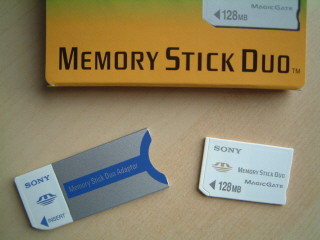
Sony's 128 Mb Memory Stick Duo has arrived in the UK (June 03). The current wheeze for data storage in Sony Ericsson mobile phones, Memory Stick Duo lets you carry photo albums, video, games and music on a slither the size of a thumbnail. It's not that regular Memory Stick wasn't small enough, but here's another physical format to follow Compact Flash, SD, MMC and the rest. It's hardly surprising that people baulk at the thought of buying into, or becoming a slave to any format. The makers would reply that this gizmo fits phones like the SE P800, massively increases its memory and so long as you can copy stuff onto it the job is done. They're pretty much right since it only matters what shape it is when you want to exchange stuff with others.
Costs more than gold
The real issue is what this costs - tax inclusive: on the US Expansys it costs $160 compared to $65 for a regular Memory Stick. In the UK Expansys sell these same for 110 and 67 UK pounds. At the Sony Style website you have a bargain where the 128Mb Duo was last seen at $104.
Incidentally, it weighs only 1.75g and thus at its best price, thus costs $60 a gram. Compare this with 24 carat gold which retails at around $24 a gram. Still that's cheaper than a bag of Loose Diamonds (tiny ones at that) costing $8000 a gram. (For the record, a one carat diamond weighing 0.2g has scarcity value and would set you back $15,000)
Copyright copy wrong
While MSD lets you store any kind of material that fits, it also features Magic Gate protection designed to protect data from being copied all over the shop. The idea is that games or music files you buy over the 'net will be tied to the MSD and not copiable or useable elsewhere. Hear anyone going wow over this?
Tuesday
I love my Internet router
Edited 2016 (Reviewed 2003)
For most folk a router is something ignore. In 2003 when I wrote this they were complicated and costly (£120). Today they're complicated and cheap (£25 up). I'd previously used ISDN for Internet access and it was good. There were tales of routers dialling up needlessly and incurring scary phone bills. But now in 2016, with Internet over cable and ADSL these are the way we go.
It used to be that if you had ADSL you had a DSL modem connected to a PC. If you had a couple of machines and maybe a ethernet linked printer you needed a hub or switch to wire them together. You could also connect a wifi access point to the hub or switch to allow a laptop with a wireless LAN card to surf, transfer files and print from around the building. The cost of this in 2002 was £120 for the modem; £60 for the hub and £120 for the wifi AP. The computer with the modem had to be switched on the whole time.
However I bought the Netgear DG824M at £140 and was really flying. After years of struggle the result was tidy and revolutionary. It was rare to find such a setup in 2003 but it established itself over the next four years. The speed was about 4Mbits/s.
The Netgear DG824M plugs into the phone line. A PC plugs into the router with a network cable (supplied).
A setup program helps your PC to find the router and configure it. This worked exceptionally well. The jargon is explained and the dial up settings are remembered by the router. The router can now be ignored indefinitely to deliver Internet as if it was electricity.
Plug another PC into the router with an ethernet cable to make a peer-to-peer network where you can share the Internet, transfer files and share printers. The DG824M has ethernet ports for three other PC's. If you have more than this you need another hub or switch.

You can connect wireless clients to the router to pick up the Internet. What you can't do is connect to it using another wireless access point. In other words, two wireless access points can't normally talk to each other.
For most folk a router is something ignore. In 2003 when I wrote this they were complicated and costly (£120). Today they're complicated and cheap (£25 up). I'd previously used ISDN for Internet access and it was good. There were tales of routers dialling up needlessly and incurring scary phone bills. But now in 2016, with Internet over cable and ADSL these are the way we go.
It used to be that if you had ADSL you had a DSL modem connected to a PC. If you had a couple of machines and maybe a ethernet linked printer you needed a hub or switch to wire them together. You could also connect a wifi access point to the hub or switch to allow a laptop with a wireless LAN card to surf, transfer files and print from around the building. The cost of this in 2002 was £120 for the modem; £60 for the hub and £120 for the wifi AP. The computer with the modem had to be switched on the whole time.
However I bought the Netgear DG824M at £140 and was really flying. After years of struggle the result was tidy and revolutionary. It was rare to find such a setup in 2003 but it established itself over the next four years. The speed was about 4Mbits/s.
The Netgear DG824M plugs into the phone line. A PC plugs into the router with a network cable (supplied).
A setup program helps your PC to find the router and configure it. This worked exceptionally well. The jargon is explained and the dial up settings are remembered by the router. The router can now be ignored indefinitely to deliver Internet as if it was electricity.
Plug another PC into the router with an ethernet cable to make a peer-to-peer network where you can share the Internet, transfer files and share printers. The DG824M has ethernet ports for three other PC's. If you have more than this you need another hub or switch.
You can connect wireless clients to the router to pick up the Internet. What you can't do is connect to it using another wireless access point. In other words, two wireless access points can't normally talk to each other.
Sunday
Micromark mains halogen light fitting proves to be a trojan horse for light bulbs
We've heard it said that an inkjet printer is a trojan horse for inkjet cartridges - the printer is sold cheap because the manufacturer makes the most money on the sale of inkjet cartridges. After all, if you use them to print stuff, you can expect to pay for the ink. Applying the same sense to home lighting hasn't worked for us.
From today we expect to save a lot of money on light bulbs. Our last Micromark GU10 Mains Halogen lamp expired in a pop today and we rejoiced. At nearly £10 each these bright and allegedly good value bulbs allow you to use halogen spot lamps wherever a transformer would be out of place. Often called simply 'mains halogen', and more succintly in this house 'a disappointment' they enable us to use some awesome hi-tech light fittings. The running cost however is another matter. In the space of a year a four-lamp fitting costing £90 has cost as much again in replacement bulbs. But now, by simply removing a few screws, the Micromark spotlight track can be dumped in the attic. This technology may one day find its moment, but just now we'll keep the fitting as a reminder. Micromark are at www.micromark.co.uk but there's no advice here. If you are similarly afflicted, cheaper replacement GU10 bulbs can be found at Argos and Ikea.
From today we expect to save a lot of money on light bulbs. Our last Micromark GU10 Mains Halogen lamp expired in a pop today and we rejoiced. At nearly £10 each these bright and allegedly good value bulbs allow you to use halogen spot lamps wherever a transformer would be out of place. Often called simply 'mains halogen', and more succintly in this house 'a disappointment' they enable us to use some awesome hi-tech light fittings. The running cost however is another matter. In the space of a year a four-lamp fitting costing £90 has cost as much again in replacement bulbs. But now, by simply removing a few screws, the Micromark spotlight track can be dumped in the attic. This technology may one day find its moment, but just now we'll keep the fitting as a reminder. Micromark are at www.micromark.co.uk but there's no advice here. If you are similarly afflicted, cheaper replacement GU10 bulbs can be found at Argos and Ikea.
Thursday
Grammar school - bargain education - demanding postage stamps with menaces
A bag of chips
Today we went to look at a propective school in Edmonton, North London so surfing took a rest. The depressing event required the measure of spiritual lift that only a bag of chips can fulfil.
North London is a reliable place to find chip shops - Hackney has one (Faulkners), Islington's Upper Street has a couple and here's another in Edmonton. I'd call it 'traditional' which means they sell no kebab but they do sell you a huge bag of chips. I'd also call this a complete meal that creates the best rush of cholesterol you can buy. It comes in flavours: cooking oil, fried chicken or fish. However we needed cheering up after this:
How to feel miserable in a couple of hours
Edmonton, North London is home to a state funded grammar school that parents clamber to get their kids into. For the reasonably well to-do, Latymer is a no-cost option to a private school. The school open day was packed, its organisation shambolic and the atmosphere seething and tense. To suffer this is the price you pay to come here. Without reflecting on the quality of the teaching that takes place, we came away that free brings its disadvantages. Hec if they're this good at marketing, just imagine how you're going to be treated as a customer.
The school's popularity has generated unusual rudeness towards parents. While teachers were only too pleased to explain their craft, the school admin staff were off-putting, discouraging and blatently rude. Their message: you're very unlikely to get your child in here, we don't need your business, go away. And this is what my taxes pay for. After years of my arguing that publicly funded education (or 'state education') was the best way, this is embarrassing.
Hilariously, this school, which clearly spends very little effort or money on marketing pleads poverty to the visiting parents. They insist on a payment to handle each application for a place. The price is a book of stamps or an asked-for shamelessly two pounds. And they're quite rude about it!
Contrast this to the annual school fairs in Islington and Hackney where some schools were happy to press a few £££ worth of glossy print in your hand. Because of an imminent move out of range of those schools we were not able to consider these schools. Nevertheless they left us with a good feeling about state schooling. The Latymer School sadly shamed it. I hope their PR improves.
Latymer grammar school - bargain education - demanding postage stamps with menaces
Today we went to look at a propective school in Edmonton, North London so surfing took a rest. The depressing event required the measure of spiritual lift that only a bag of chips can fulfil.
North London is a reliable place to find chip shops - Hackney has one (Faulkners), Islington's Upper Street has a couple and here's another in Edmonton. I'd call it 'traditional' which means they sell no kebab but they do sell you a huge bag of chips. I'd also call this a complete meal that creates the best rush of cholesterol you can buy. It comes in flavours: cooking oil, fried chicken or fish. However we needed cheering up after this:
How to feel miserable in a couple of hours
Edmonton, North London is home to a state funded grammar school that parents clamber to get their kids into. For the reasonably well to-do, Latymer is a no-cost option to a private school. The school open day was packed, its organisation shambolic and the atmosphere seething and tense. To suffer this is the price you pay to come here. Without reflecting on the quality of the teaching that takes place, we came away that free brings its disadvantages. Hec if they're this good at marketing, just imagine how you're going to be treated as a customer.
The school's popularity has generated unusual rudeness towards parents. While teachers were only too pleased to explain their craft, the school admin staff were off-putting, discouraging and blatently rude. Their message: you're very unlikely to get your child in here, we don't need your business, go away. And this is what my taxes pay for. After years of my arguing that publicly funded education (or 'state education') was the best way, this is embarrassing.
Hilariously, this school, which clearly spends very little effort or money on marketing pleads poverty to the visiting parents. They insist on a payment to handle each application for a place. The price is a book of stamps or an asked-for shamelessly two pounds. And they're quite rude about it!
Contrast this to the annual school fairs in Islington and Hackney where some schools were happy to press a few £££ worth of glossy print in your hand. Because of an imminent move out of range of those schools we were not able to consider these schools. Nevertheless they left us with a good feeling about state schooling. The Latymer School sadly shamed it. I hope their PR improves.
Latymer grammar school - bargain education - demanding postage stamps with menaces
How to while away some time: try digital video
Here's a tip you'd easily miss. Buy the very latest greatest digital camcorder and then put it in the cupboard for a few years while computers become fast enough, and the software gets good enough to edit digital video. Be sure to do this on a PC rather than a Mac because this ensures a level of usuability we're looking for. Better still buy a Sony Camcorder in the MicroMV format range, open the box, find the recommendation and information on where to buy Pinnacle Studio 7 DV Editing software and of course buy it. You should then discover that Pinnacle have a facinating marketing dept that lets it's imagination rip with their product's capabilities. Were you into using up time, you may experience massive disappointment to find it worked - but that's not the case. Next email tech support and wait for no answer. Wait and do nothing for a year till Studio 8 is released and now works with Sony's MicroMV. Get this and pass the time with error messages that say 'Capture error'. Puzzle further, peruse tech support to find that it didn't work on release. Nexr realise why the person on the box shot is smiling. She got Pinnacle to refund her money and got herself a life and an Apple Imac. I use a PC and must therefore cheer myself up with food.
Update
Sony need to take the blame for inventing this format in the first place. The Sony (Memory Stick) Company is known for inventing things that connect only to Sony. To be fair it was brave of Pinnacle to try to build a bridge between the format and the rest of the world. There's hope as today Pinnacle's US Product Manager agreed that there had been a delay in the compatibility with Sony MicroMV and it is being rectified right now.offers this statement to explain things: "While MicroMV support was planned for the initial release of Studio 8, unforeseen difficulties were encountered in supporting this new format. We are working closely with Sony to resolve these difficulties, and a free Studio 8.3 update with full MicroMV support should be available on the 15th September.".
The patch didn't arrive. As Pinnacle's webboard shows us, setting a date does not make things happen.

Pic: You'd really smile if you got your money back
Update
Sony need to take the blame for inventing this format in the first place. The Sony (Memory Stick) Company is known for inventing things that connect only to Sony. To be fair it was brave of Pinnacle to try to build a bridge between the format and the rest of the world. There's hope as today Pinnacle's US Product Manager agreed that there had been a delay in the compatibility with Sony MicroMV and it is being rectified right now.offers this statement to explain things: "While MicroMV support was planned for the initial release of Studio 8, unforeseen difficulties were encountered in supporting this new format. We are working closely with Sony to resolve these difficulties, and a free Studio 8.3 update with full MicroMV support should be available on the 15th September.".
The patch didn't arrive. As Pinnacle's webboard shows us, setting a date does not make things happen.

Pic: You'd really smile if you got your money back
Today the computer has a rest
Thanks to some woe at the ISP, much of the day's work was blitzed. Life has come to a halt. There is niet, nought and nothing to click on. There is niet to eat also so this nietness is complete. All that's now deemed edible is on the larder baking shelf - and this Plain Chocolate flavour block quickly won the battle for my attention. A bag of Ground Nuts was envious. The Glace Cherries were gutted.
After all that, and a few bites later, this bar has never seen chocolate. It may have briefly looked at some but it learned nothing from that. It's taste and texture cannot be recommended to readers. This cooking chocolate is to chocolate, what Windows XP is to anything else. It's a cosmetic covering to hide whatever's beneath it.

Pic: Cooking chocolate - cure for chocolate addiction
Thanks to some woe at the ISP, much of the day's work was blitzed. Life has come to a halt. There is niet, nought and nothing to click on. There is niet to eat also so this nietness is complete. All that's now deemed edible is on the larder baking shelf - and this Plain Chocolate flavour block quickly won the battle for my attention. A bag of Ground Nuts was envious. The Glace Cherries were gutted.
After all that, and a few bites later, this bar has never seen chocolate. It may have briefly looked at some but it learned nothing from that. It's taste and texture cannot be recommended to readers. This cooking chocolate is to chocolate, what Windows XP is to anything else. It's a cosmetic covering to hide whatever's beneath it.

Pic: Cooking chocolate - cure for chocolate addiction
Wednesday
Play shopping for shops on the web
If you buy technology on the web, the firms pretty soon sort themselves out into good and less good. Give yourself a budget of a few grand and award points to the shopping sites using these criteria.
Point one is for the site with all the information you need to buy. Dabs.com do this excellently and get a deserved point here.
Point two is for whether the site shows a genuine stock level and do actually deliver. A few firms have done this excellently. Award negative points if a firm says it’s in stock and then, when you've ordered, sends a whingy email reinterpreting the meaning of 'in stock'.
Point three is for how well they split orders when things are in or out of stock.
Point four is whether they do anything at any speed when you click Checkout. (Order something from cclcomputers.com, wait a few days and then cancel and go elsewhere. Dabs.com win awards for their site but what they mean by next day delivery is measured by the days on planet Pluto. Dabs always disappoints. Ebuyer never disappoints as long as you realise that the firm really wants to go out of business. This this they do by messing up often.
Point five is negative marks for all the excuses you will get when the wrong things are sent, things don't work.
Point six is for a customer helpline that's effective. Several firms (e.g. Dabs, Ebuyer) have 'virtual customer helplines' meaning that there's a number but the response time is a ridiculous seven days.
I’ll return to this later, but first there’s money to be shed
Point one is for the site with all the information you need to buy. Dabs.com do this excellently and get a deserved point here.
Point two is for whether the site shows a genuine stock level and do actually deliver. A few firms have done this excellently. Award negative points if a firm says it’s in stock and then, when you've ordered, sends a whingy email reinterpreting the meaning of 'in stock'.
Point three is for how well they split orders when things are in or out of stock.
Point four is whether they do anything at any speed when you click Checkout. (Order something from cclcomputers.com, wait a few days and then cancel and go elsewhere. Dabs.com win awards for their site but what they mean by next day delivery is measured by the days on planet Pluto. Dabs always disappoints. Ebuyer never disappoints as long as you realise that the firm really wants to go out of business. This this they do by messing up often.
Point five is negative marks for all the excuses you will get when the wrong things are sent, things don't work.
Point six is for a customer helpline that's effective. Several firms (e.g. Dabs, Ebuyer) have 'virtual customer helplines' meaning that there's a number but the response time is a ridiculous seven days.
I’ll return to this later, but first there’s money to be shed
Tuesday
What to do on the web: Play the signup game:
Here's a game for two if you have a friend, through you can still play and gain a thrill on your tod. To get started, go to a website which features a 'register for free' service and sign in. After you register you'll receive a confirmatory email (which you can have sent to your barely-usable Hotmail account). You use the info on the email to sign back into the site.
How the scoring works: Every site you successfully sign into gains you two points. Every site that rejects you, despite your checking that email, gains you TEN points. To get the high scores you really need to sign up with a pay as you go ISP where you'll get rejected trying to dial up via a modem. As well as winning points, the cost of the calls adds a lot of tension, and fun to the game! Places to start include Tiscali where you can sign up for a £15 a month deal, try to change it later but have your 'sign into the account' rejected repeatedly. You gain loads of points for that. At some point Tiscali will change the log in procedure without telling you such that you will need a completely different User ID and password to the one you have been sent. This means only one thing: you win that game, no problem!
I decide it's time to do a cookery course?
If you too could barely scrape a pass in toast mangement, you'll be wondering if there's a way to a brighter future though learning to prepare food well. There's the prospect of a chunk of your leisure life becoming pleasurable balanced against the pleasure you'd gain learning things on the web. If you've been following our progress todate you'll appreciate this latest discovery: there are cookery sites on the web and it's taken me this long to find one.
Subscribe to:
Posts (Atom)